

Thoughts are Echoes of the Mind
Learning from the design of the character 意
Thoughts are the sounds of the mind.
This is the deep insight embedded in the form of the character 意.
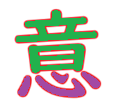
The top part is 音, or “sound. The bottom part is 心, or “mind”. So this character combines those two meanings to represent “the sound of the mind”, with the meaning of “thoughts”.
It’s strange, isn’t it—we see this character every day and all the words it appears in like 意味 (imi, meaning) and 意志 (ishi, intention) and 意図 (ito, aim) and 任意 (nini, arbitrary) and 意義 (igi, significance) and 意向 (ikou, inclination) and of course 意見 (iken, opinon), and yet how often do we really look at it? The sound and the mind are right there staring us in the face.
If you prefer a more poetic formulation, we can say “thoughts are the echoes of the mind”, or “thoughts are the voice of the mind”, or “thoughts are the songs of the mind”, or “the mind speaks in ideas”, or even “the language of the mind is meaning”.
(By the way, about that 音 character. It has nothing to do with standing (立) or the sun (日). The bottom part represents a mouth, and the top part used to be a tongue, so it’s someone speaking, hence “sound”. Another theory is that the bottom part is an altar, and the top part is sounds rising up from it. In yet another theory, the 音 part of this character is just a relatively recent transformation from an unrelated glyph, invalidating our entire theory—but it’s still a wonderful mnemonic.)
In other words, this character represents what its Chinese designers thought of as the (non-)vocal output of the mind. It might be a thought. It might be an idea. It might be an intention. It might be a wish. It might be an understanding. It might be a sense. It might be a reason. It might be a meaning. These are all meanings of the character 意.
Why “Mind”?
You might wonder why I’m using the word “mind” for 心. Well, that’s because this is a Chinese character invented by Chinese and therefore the 心 in 意 has Chinese meanings and nuances. And those are different from 心 (and kokoro) in Japanese. In Japanese, the nuances associated with the native word kokoro have osmosed back into the character 心. The ancient word kokoro bundles all kinds of ideas about inner feeling, spirit, will, emotion, perception, intent, thought, authenticity, nature, intuitiveness, and awareness. It is the entire, intrinsic essence of something or someone. It’s their center, it’s their core. It has a profound spiritual and aesthetic resonance. We find it used in waka, haiku, Zen, and Noh to refer to the essence or spirit of a thing.
In Chinese, in contrast, 心 was and is more about the center of cognition and moral thought and mental state. No wabi sabi stuff going on here. In Buddhism, which flourished in China before coming to Japan, they talk about 無心 (mushin) to refer to discarding this cognitive aspect of mind. There’s a reason that the Zen concept of 初心 (shoshin) is usually translated as “beginner’s mind”. Or 仏心 (busshin) as “Buddha mind”.
In other words, although this character is used in both Japanese and Chinese, its nuance, usage, and emotional resonance differ significantly betwen the two. The character is the same but the cultural and emotional gravity are different.
In the Manyōshū (万葉集) Poem No. 1633 (Book 8), we find:
手もすまに植ゑし萩にやかへりては、見れども飽かず、心尽さむ
Coming home to the bush clover I planted in such haste, I gaze and gaze and never tire, until my heart is spent.
Here, こころ尽さむ (kokoro tsukusamu) expresses being emotionally overwhelmed, a heart that is exhausted. We see the emphasis on the emotional, affectual aspects of kokoro.
So that is why I use “mind” for the 心 radical at the bottom of 意.
Consciousness
And what would it be called if we could perceive or sense these voices from our mind, our thoughts? In an upcoming post, we will talk about 意識 (ishiki, consciousness).