

What exactly is ginjo sake?
Most people who drink sake learn right off the bat that a ginjo (吟醸) or daiginjo (大吟醸) means something exceptional is happening in the bottle.
But how many know that the key distinction between ginjo and “lesser” sakes is primarily the polishing ratio of the rice grains? In Japanese, this is called seimai buai (精米歩合). For ginjo, the rice grain must have been milled to 60% away before being used for fermentation. For daiginjo, it’s a minimum of 50%, and some premium daiginjo push further down to 35%, or even 23%. \
What remains after the milling is the starchy, protein-free inner core (心白, shinpaku) used for brewing. What’s removed is the outer layer of the grain—proteins, lipids, and minerals that introduce zatsumi (雑味, “miscellaneous flavor,” the technical term for off-notes and harshness). Polishing strips it away and exposes the starchy inner core. The further you go, the more delicate the result, and the more rice you discard (and the greater the cost). Today, new rice breeds are developed specifically with an eye towards “millability” for sake making, meaning their precious core of starches is more centered and round, making milling more efficient.
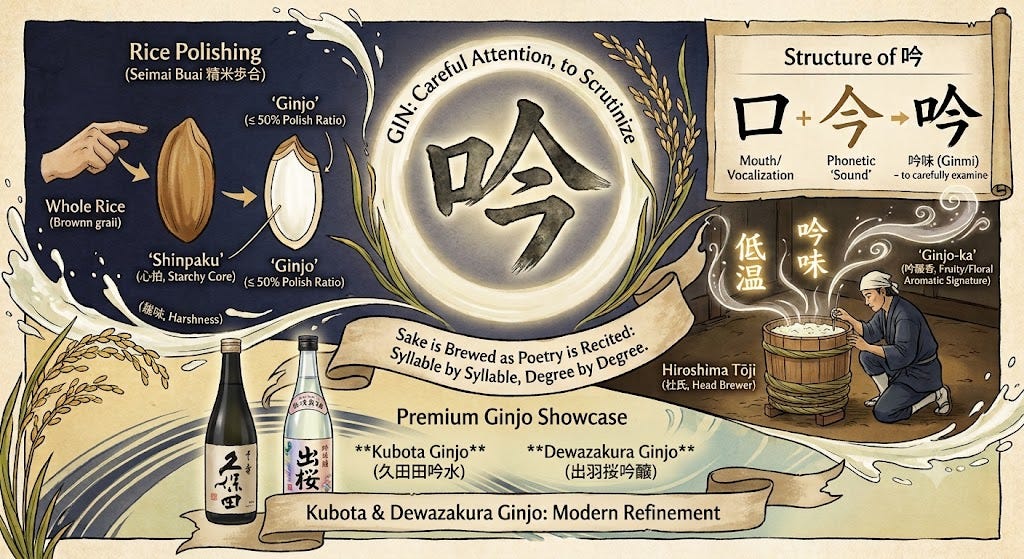
And how many students know, much less can write, the character 吟 (gin), which is not encountered very often in everyday life? Its primary meaning is to chant, to recite poetry—the sound of a voice (hence the mouth radical) carefully attending to rhythm and meaning. The most common compound you will encounter using this character is ginmi (吟味), which means to carefully examine, to scrutinize, to weigh something with full attention. You ginmi a contract before signing. You ginmi a candidate before deciding. The word applies to business meetings, editorial discussions, contract negotiations—anywhere deliberate scrutiny is being applied. It’s common enough that it turns up in news coverage, in fiction, in everyday office speech. The word originally meant something like “chewing over” a poem—attending to it the way a reciter does, syllable by syllable, nothing rushed. Over time it generalized into any kind of deliberate, unhurried examination. But 吟 kept carrying that quality of focused, concentrated attention. Your word of the day is 吟味!
The connection to sake is that when a brewer makes ginjo, they’re attending to their sake the way a poet attends to every syllable—吟味 applied not to a text or poem but to fermentation, the entire process managed with care that borders on ritual.
The character 吟
The structure of 吟 is straightforward: the radical is 口 (mouth, kuchi-hen), and the component 今 (ima) functions as a phonetic, providing the sound, not the meaning. The 口 tells you this character has to do with vocalization; the 今 merely gives you a clue to the phonology. This is a classic 形声文字 (keisei moji). The standard English term for this, and the one I’ve always used in Nihongoism, is phono-semantic compounds, but recently I’ve seen alternative terms like pictophonetic, or semasio-phonetic.
You might assume that a specialized character like this, more at home in a poetry salon than on the street, wouldn’t be on the Jōyō kanji list, but actually it is. 吟 made the list largely because of ginmi, which turns up in business and everyday speech. The sake connection is incidental to why it’s Jōyō.
This character has no kun-yomi.
Like any other character worth its salt, 吟 can be used in wildly creative Japanese first names, sometimes with the reading oto. How about Mioto for your next kid, spelled 美吟?
Explore the character 吟 on Kanjiism.
The second character of ginjo is 醸 (jō), which is just brewing. Its left-side radical is 酉, the “fermentation vessel” radical, the same component that appears in 酒 (sake, liquor), and 酢 (vinegar), and 酸 (sour, acidic). 酉 is a pictograph (象形文字, shōkei moji) of an ancient jar with a narrow neck, a vessel specifically associated with fermentation and aged liquids. In Japanese it’s called tori-hen; did you know that? That name came from the character’s use in the Japanese zodiac; the radical obviously has nothing to do with birds. In English it’s just the “wine radical” or “sake radical”.
I don’t know about you, but the kun-yomi of this character escaped my notice for the longest time, or if I did notice it it didn’t stick, perhaps because there really aren’t that many opportunities to use it. It’s kamosu (醸す). This connects to kamu (嚙む, to chew), and specifically to kuchikamizake (口噛み酒, “mouth-chewed sake”), mentioned in the Kojiki. In ancient practice, people would chew uncooked rice and spit the mash into a vessel, where salivary amylase began converting starch to sugar. Kamoshi, the product of the chewing process, became the verb kamosu. When the character 醸 arrived from Chinese, it was mapped onto this existing native concept.
Modern kamosu has generalized into an abstraction for anything that “brews” slowly and then arrives. I asked my native informant for an example and she came up with 幸せの雰囲気を醸し出す (shiawase no fun’iki wo kamoshidasu) . We’ll leave the translation of that to the reader.
The advent of ginjo
The word ginjo-shu (吟醸酒) is 130 years old. It is a Meiji-era coinage, invented to name a new style of brewing. Its earliest documented appearance is in a brewing manual in 1894. The term then surfaces again in the Brewing Association Magazine in 1906 and in Chikashi Kanomata’s Brewing Laboratory Report in 1909. Witness the birth of a new word.
The occasion that consolidated the term was the National New Sake Competition, established in 1907: 全国新酒鑑評会 (Zenkoku Shinshu Kanpyōkai). In the competition’s first years, sake from Hiroshima swept the top awards, beating the traditional powerhouses of Nada in Hyogo and Fushimi in Kyoto. This was not supposed to happen.
The reason comes down to water. Nada’s famous miyamizu (宮水) is hard water, high in minerals, which makes fermentation vigorous and fast—the backbone of the robust, food-friendly styles that had dominated the market for centuries (and still is the largest sake-producing area in Japan), made by a practice known as, well, fast brewing (促醸, sokujō). Hiroshima’s water is soft, almost mineral-free. Soft-water fermentation is sluggish and sensitive; it goes wrong easily. The Hiroshima toji (杜氏, head brewers) had spent years solving this problem. Their answer was to slow everything down deliberately: lower fermentation temperatures, longer timelines, more careful attention at every stage. More ginmi, in exactly the sense the character implies. The style that emerged from this constraint produced sake with exceptional delicacy and aroma, and won competitions because it was doing something the judges hadn’t encountered before.
For much of the twentieth century, ginjo remained limited to competition. The labor and precision involved made it economically impractical for the market: a brewery might produce a few to (斗, roughly 18 liters, ten of those big 1800ml isshobin bottles, 一升瓶) for the annual competition and nothing more. Ordinary drinkers never saw it; Ginjo was sake brewed to be judged.
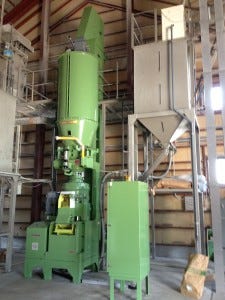
Two developments were the key to widespread commercialization. The first was mechanical: vertical rice-polishing machines, introduced around 1930, which made extreme polishing feasible at commercial scale.
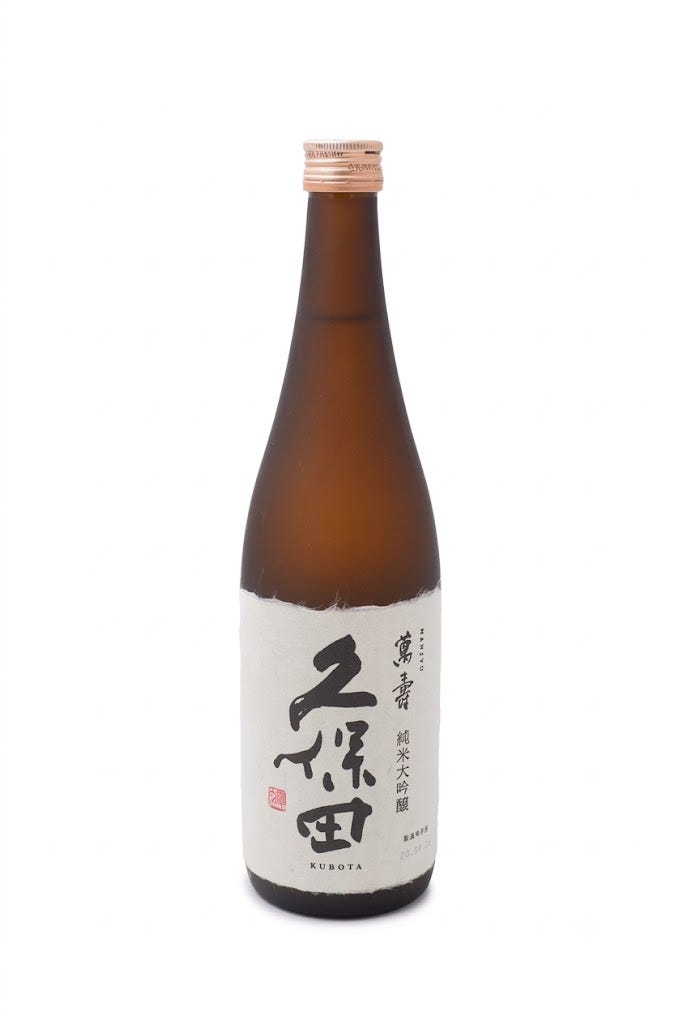
The second was thermal: refrigeration and temperature-controlled fermentation, which spread through the industry in the 1970s and 80s, allowed breweries to apply competition-grade precision to commercial volumes for the first time. That era’s surge of interest in premium sake—the sake boom of the 1980s—brought ginjo to retail shelves. Kubota, a lovely brand from Niigata that I have consumed far more than my fair share of, was among the producers who made it something you could actually buy. I remember when it was considered a niche brand. In 1980 Dewazakura (named after the old Japanese kuni Dewanokuni, which as you may know roughly corresponds to present-day Yamagata and Akita) brought its ginjo to market. With its restrained lightness characteristic of Tohoku, this sake excels in “drinkability” and is a favorite of mine and other household members. I’ve been learning more and more about sake and recently was awarded the credential of “Certified Sake Professional”, which has made my sake consumption experience much more enjoyable, plus has given me the opportunity to expound endlessly to my hapless companions about sake arcana.
For authoritative information about sake and the sake industry, look no further than the ultimate sake expert John Gauntner, right here on Substack.
Useful compounds with 吟 and 醸
吟味する ginmi suru to scrutinize; to examine carefully
吟醸 ginjo attentively brewed sake (≤ 60% rice remaining)
大吟醸 daiginjo grand ginjo (≤ 50% rice remaining)
吟醸香 ginjo-ka the fruity/floral aromatic signature
醸造 jōzō brewing, fermentation
醸造所 jōzōsho brewery
醸成 jōsei to foster, bring about gradually (learn this one!)
醸す kamosu to brew; to give rise to, stir up
Homework
Sake brewers discard up to 65% of the grain to make daiginjo, polishing away everything that obscures the essential. Is there another art or culinary form where the work is mostly subtraction? Does the parallel hold?
Also a Kubota fan.
PS another sake substack is https://sakefromthesource.substack.com/ I suspect you and that author have much in common