

Why does Japanese use the same character for "luck" and "carry"?
When a Japanese speaker says un ga ii (運がいい), they mean someone is lucky. When they say unten (運転), they mean driving. When they say un’yu (運輸), they mean freight transport. These don’t feel like they belong together. But in fact they share a surprising deeper meaning.
Of course I’ve known the word 運転 for driving and the word 運 for luck for a long time, but it was only recently that I suddenly noticed they used the same character!
The kun reading of 運 is hakobu (運ぶ), meaning to carry or to transport, and that is the concrete root from which everything else grows. The related noun hako (箱, box or container) is likely derived from this verb—the thing used in the act of carrying takes its name from the carrying itself, which suggests that hakobu is the more fundamental concept. Before 運 acquired any philosophical weight, it designated the physical act of moving things from one place to another.
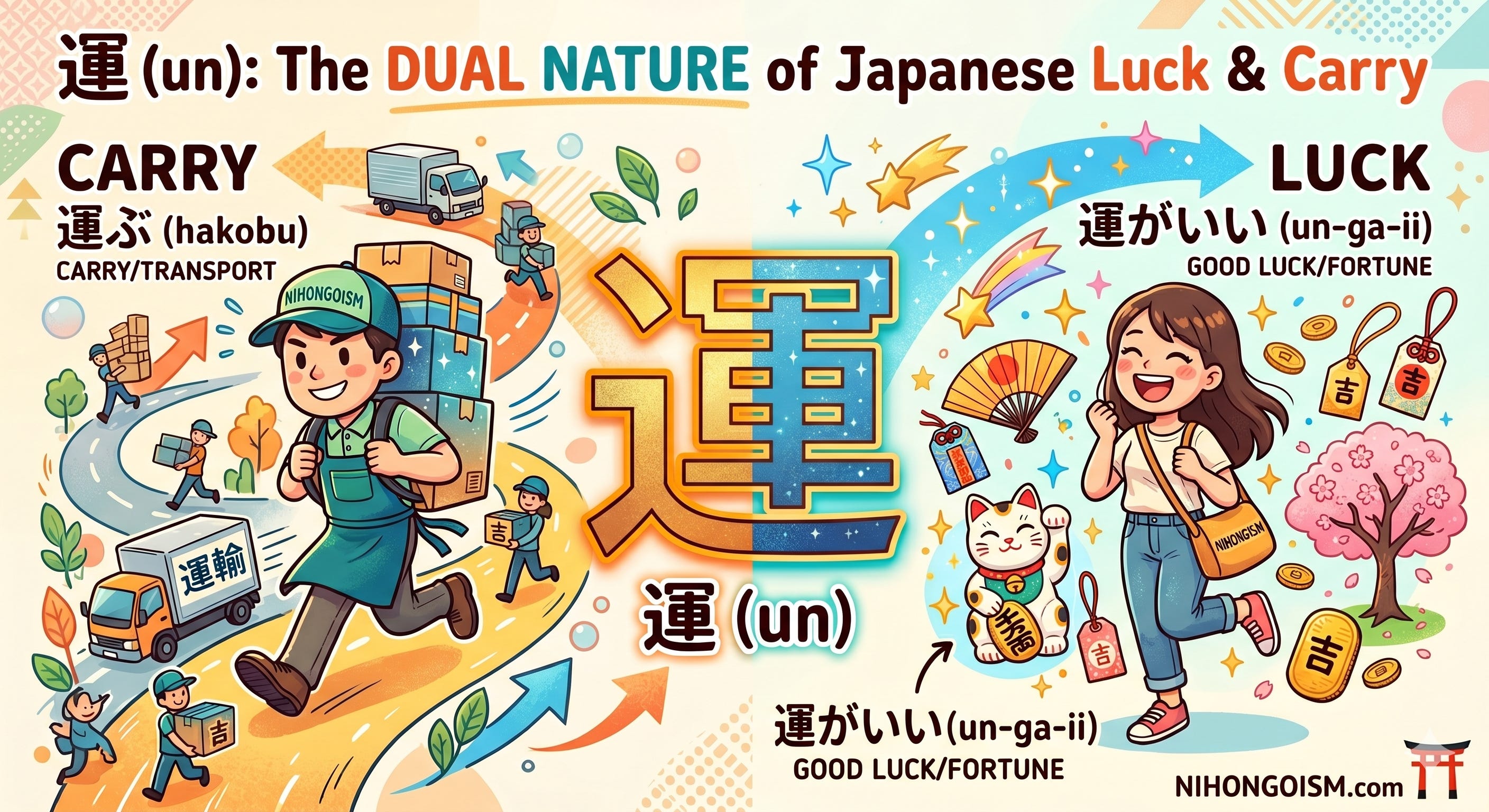
The range of hakobu is wider than it might first appear, as is so often the case for words that we examine here. You can say nimotsu wo hakobu (荷物を運ぶ) for carrying luggage, but you can also say ashi wo hakobu (足を運ぶ) — literally “to carry one’s feet” — as an expression for making a visit, taking the trouble to go somewhere. In that idiom, the body itself becomes the cargo, which gives a sense of how the verb works: it is about the intentional movement, of something meaningful, for some distance.
It’s a mystery what the bu of hakobu might mean. Unlike other verb-ending syllables like gu, which has nuances of moving and sliding (oyogu, shinogu, tsugu), the few verbs ending in bu (others inlcude yorokobu and asobu) don’t seem to have anything special in common.
The Chinese Character
The character 運 has two visible components. Wrapped around the bottom-right is 辶, the shinnyo radical—a stylized image of a foot on a road—which shows up in dozens of characters. Anything with 辶 is about motion, or passage, or direction. On the right side is 軍 (gun), which means army or military force, and which has 車 (kuruma/sha)—the character for vehicle, one of the clearest pictographs in the kanji system, a wheel and axle seen from above—embedded inside it. 軍 depicted a covered military chariot; the army that commanded such vehicles became the character’s primary meaning. In the standard analysis, 軍 functions as the phonetic component: its on’yomi is gun, and dropping the initial consonant gives un, the reading of 運. The bonus is that 軍’s semantic content—vehicle, through the 車 inside it (see our previous article on the topic)—reinforces the transportation meaning of the whole character at the same time, a kanji construction trick we have highlighted over and over, and which ought to have its own name, which I will hereby confer on it: 形声意文字, where we insert the 意 to indicate the there is a second meaning-related component in the character. 形声文字 is “phono-semantic character” in English, so our new term could be “phono-compound-semantic character. You heard it here first.
The word hakobu has existed since the days of old Japanese. One interesting use in Middle Japanese occurs in Dōgen’s 現成公案 (Genjō Kōan):
自己をはこびて万法を修証するを迷いとす、万法すすみて自己を修証するを悟りとす。
We will defer a complete exposition of this sentence and some possible translations to a future article. Suffice it to say that here Dogen is referring to “carrying around the self”, or “carrying yourself around”, or if you prefer “lugging yourself around”, or “carting yourself around” or ‘hauling yourself around”, as a form of delusion. The same verb that moves freight moves the self through the territory of awakening and confusion, which is a remarkable range for a word that starts with luggage.
But why luck?
The leap from “carrying things” to “luck” (or “destiny”, or “fate”) follows naturally from how classical Chinese thinking understood fate and fortune: not as static conditions but as things that circulate and flow and move through time. Your un is what the currents of circumstance carry your way, and un ga ii implies something more like a favorable current moving in your direction than a fixed state of being. The Chinese root 運 (Mandarin yùn) carried the full range or both transportation and the circulation of fate, and Japanese received both meanings intact when it borrowed the character.
Modern compounds reflect both domains without any sense of contradiction. Ones you might want to bone up on include:
運動 undō movement; exercise; campaign
運輸 un’yu transportation, freight
運命 unmei fate, destiny
運営 un’ei management, operation
幸運 kōun good fortune;
不運 fuun misfortune
運動 (undō) covers both jogging around the park and a political movement for the same reason: both are things that move, that circulate, that carry people somewhere. And 運命 (unmei, fate) pairs 運 with 命 (inochi/mei, life), making fate the movement of life through time.
Homework
Homework #1: 運 and 搬 (han) are close in meaning—both involve carrying or transporting—but 搬 has never developed the “luck” or “fate” sense that 運 has. What is different about 搬 that blocked that metaphorical extension, and what does 運 have, or what is 軍 doing, that made the leap possible?
Homework #2: Why did Japanese assign no kun-yomi to the character 運 in its meaning of “fate”?
Kata
We will pick up the topic of the remarkably versatile and productive word kata very soon.
Note to our readers
We’re grateful fo allour readers and especially paid subscribers. We know that our content is bit specialized and published less frequently than some of the other publications you might subscribe to.
We’re pleased to make it a bit easier to subscribe by offering this 50% discount off monthly and annual subscriptions.
This is a wonderful article. The way you draw on that famous passage from Dōgen's Genjō Kōan, where the verb hakobu (here written in kana, はこびて) is used for "carrying the self," something Zen treats as delusion, and use it to bring out the real character of 運ぶ, is brilliant. Thank you.
This was a truly fascinating read. Even as a native Japanese speaker, the way you unpacked the characters that make up “運命” was an eye-opening moment for me. Thank you for the wonderful insights, and I look forward to your future articles.